Technical Systems – Equipment and Rope Systems
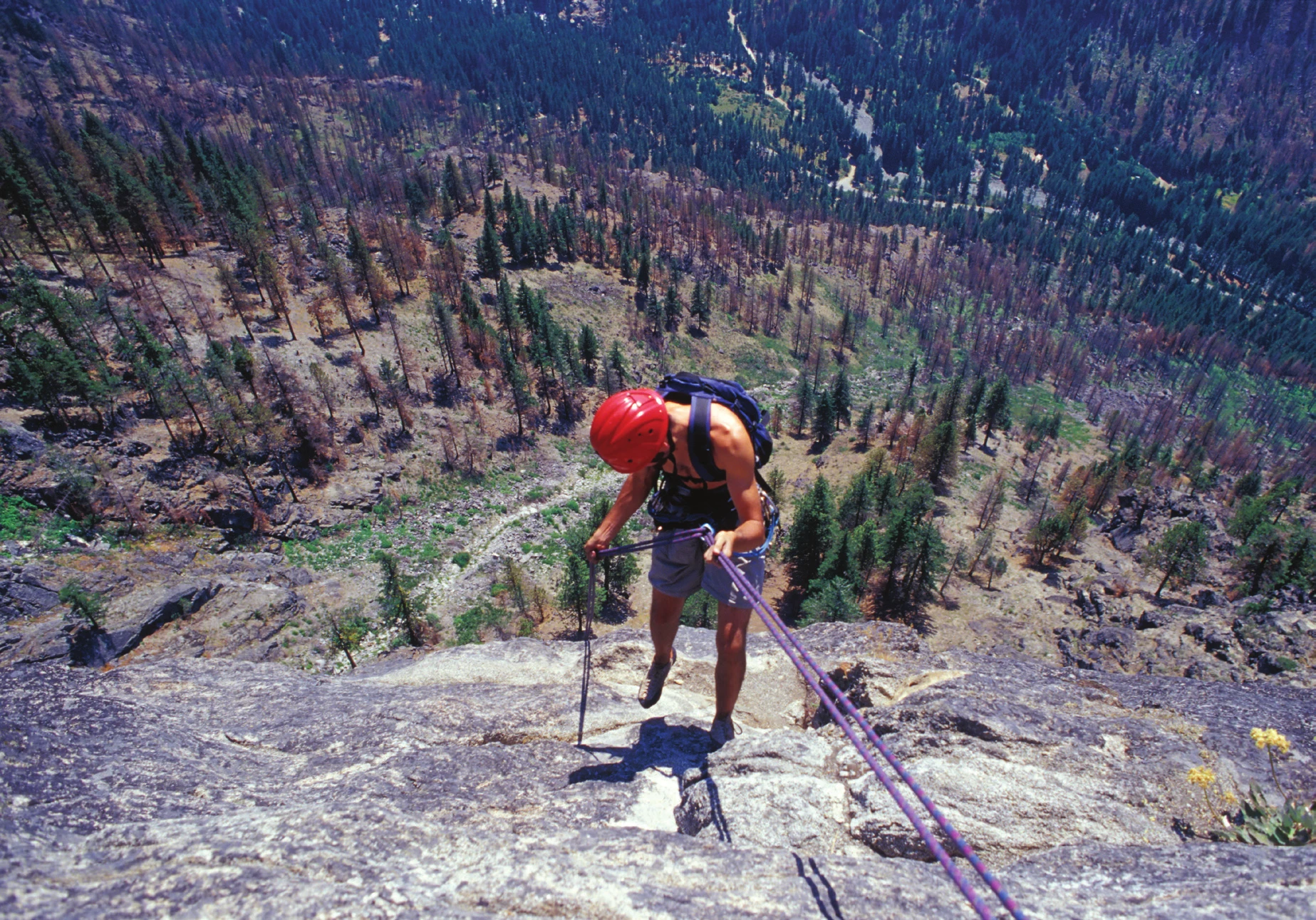
In this chapter we will explore hard and soft goods, as well as their applications in creating technical systems that minimize the risk to participants while partaking in top rope climbing activities, and allow leaders to facilitate rescues if required.
Equipment
With the exception of helmets and personal gear, most technical equipment can be classified into one of two categories: either hard goods such as carabiners and belay/rappel devices; or soft goods such as ropes, cord, and slings.
Ropes
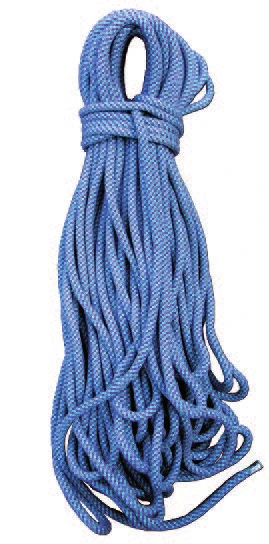
Ropes come in two varieties: dynamic ropes which are designed to absorb force and dissipate it through their elongation; and static ropes which are designed for applications that do not require the rope to absorb force. In the top rope climbing context, dynamic ropes rated by the manufacturer as 'single ropes' should be used for all belayed climbing activities. In an effort to make dynamic climbing ropes lighter, many rope manufacturers have developed lower diameter single dynamic climbing ropes. While lightweight low diameter dynamic climbing ropes have many applications in the multi-pitch climbing environment, they have limited purpose in the top rope climbing context. For durability, ease of handling, and belaying purposes, dynamic climbing ropes in the 9.8 millimetre to 10.5 millimetre range are recommended for top rope climbing activities.
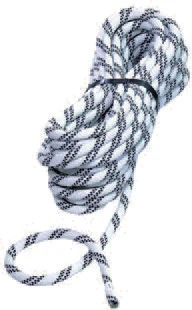
Static ropes, while not useful for belayed climbing activities, can be invaluable to the top rope leader when extending or constructing large anchors, or establishing a fixed line rappel. Similar to dynamic rope, static rope comes in a variety of diameters. For anchor applications and fixed line rappels, larger diameter static rope in the 10-11 millimetres range is preferable. Static rope is commonly sold by the metre off a spool, for most top-rope anchor applications a section 25 metres in length is sufficient.
Cord
Cord, commonly referred to as accessory cord, is essentially lower diameter static rope that can be used to create hitches. 7 millimetre cord is the preferred diameter for rope ascending, and for improvised rescue applications. Due to its lower diameter it is important that the top rope leader understand the strength limitations of cord, and ensure that in any full-load bearing application the cord is doubled. Two five-metre lengths, and one one-metre section of cord are commonly carried by the top rope leaders.
Harnesses
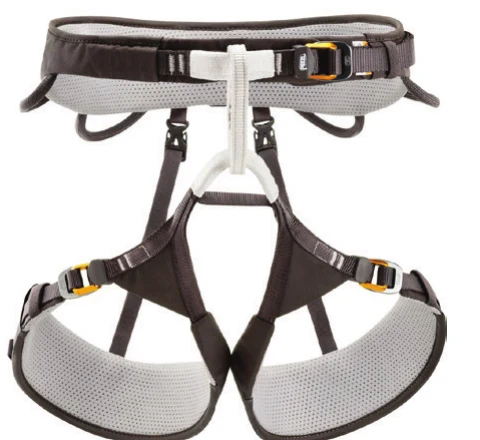
Top rope climbing harnesses need to be commercially manufactured sit harnesses designed for the purpose of recreational climbing. They must have a designated waist belt, leg loops, as well as tie-in points, and a vertically oriented belay loop.
Slings
Slings are commercially sewn closed loops of nylon material that come in a variety of lengths. They are commonly used to connect carabiners to create a quickdraw, to construct anchors, or as a tether when tethering to an anchor.
Webbing
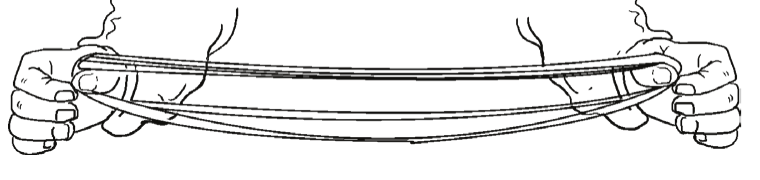
Whenever practical it is preferable to use commercially sewn slings rather than bulk nylon webbing. In some instances, such as anchor extensions or large anchor configurations, it may be desirable for the top rope leader to have a 10 metre section of 1-inch tubular nylon webbing available.
Carabiners
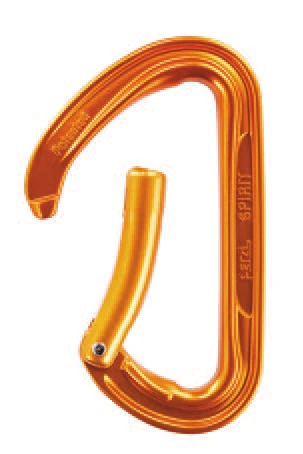
Carabiners can be either locking or non-locking and constructed of either aluminum or steel. The majority of carabiners used in modern climbing activities are aluminum due to their lightweight properties in comparison to steel. However, in a top rope climbing context, steel carabiners may be preferable at the master point of an anchor due to their durability and decreased rope dirtying (oxidizing) properties.
Non-locking carabiners may be used at non-critical connection points. These are the connection points in a technical system that would not have catastrophic consequences if they were to fail. All critical connection points in a technical system should employ locking carabiners. In situations where movement of the critical connection point is anticipated and monitoring of that point will be limited, such as the master point of a top rope anchor, two locking carabiners should be used.
Belay and Rappel Devices
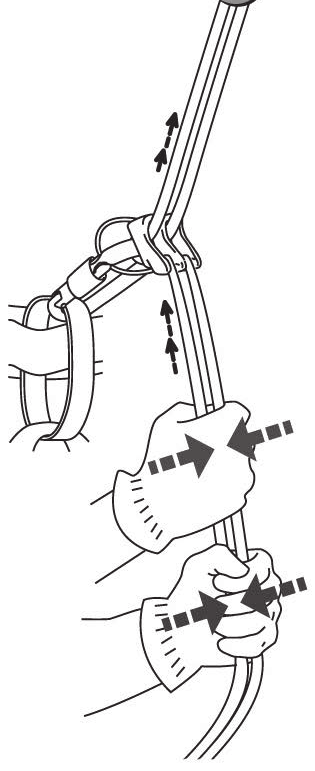
Belay and rappel devices can be either manual braking or assisted braking. Manual braking belay devices create friction by forcing tight bends into the rope. Assisted braking belay devices employ either a moving component, or binding action on the rope to create friction. In some instances, the use of assisted braking belay devices may be preferable as these devices can increase participant comfort and safety. Manual belay and rappel devices may be preferable for rappelling activities or for instances where participant belayers have previously demonstrated competency in their belay skills.
Helmets
Helmets designed for the purpose of recreational climbing must be worn at all times when a fall or overhead hazard is present.

Inspections and Lifespan
Prior to using any equipment, it should be visually and manually inspected to ensure it is fully operational and in good repair.
Equipment Inspections
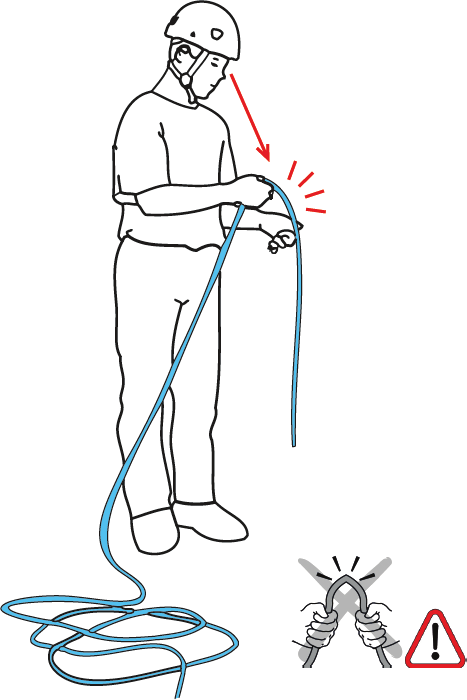
Soft goods such as ropes, slings, and harnesses should be visually inspected and manually manipulated to check for excessive wear, and/or inconsistencies in material shape or feel prior to use. Notable hard spots, soft spots, signs of excessive abrasion, melting, and/or inconsistent feel are indicators of damage and the need for the equipment to be removed from use. Climbing helmets should be checked for cracks in the outer shell, damage to inner foam, and proper functioning of all sizing and fitting components.
Hard goods such as carabiners and belay devices should also be inspected prior to use. Excessively worn carabiners and belay devices (more than 25% of the material diameter), sharp edges created by wear, and poor operation of moving components such as carabiner and assisted braking device hinges, all indicate damage and removal from use.
Many modern climbing harnesses are constructed with 'wear indicators' at the tie-in points. When wear indicator 'threads' appear at tie-in points, this signifies the need to remove the harness from further use.
Equipment Lifespans
All commercially manufactured soft goods are given a maximum usable lifespan. For most nylon goods this is 5 years from the date of manufacture. Inspection records and date of manufacture should be tracked for all soft goods being used for top rope climbing activities. In situations where a piece of equipment has attained the manufacturers maximum usable life span, it must be retired even if it appears to be in good repair.
Hard goods have an indefinite lifespan and only need to be retired in instances where there are visible signs of damage or significant wear.
Due to the nylon chin strap and degrading properties of the foam used in climbing helmets, their maximum usable lifespan is often consistent with that of other soft goods.
Knots
Knots are used in ropes and sling material for three main purposes: to create closed loops that allow the connection of various components in a technical system; to create a barrier at the end of a rope; and to connect two pieces of material together.
Figure Eight Follow Through
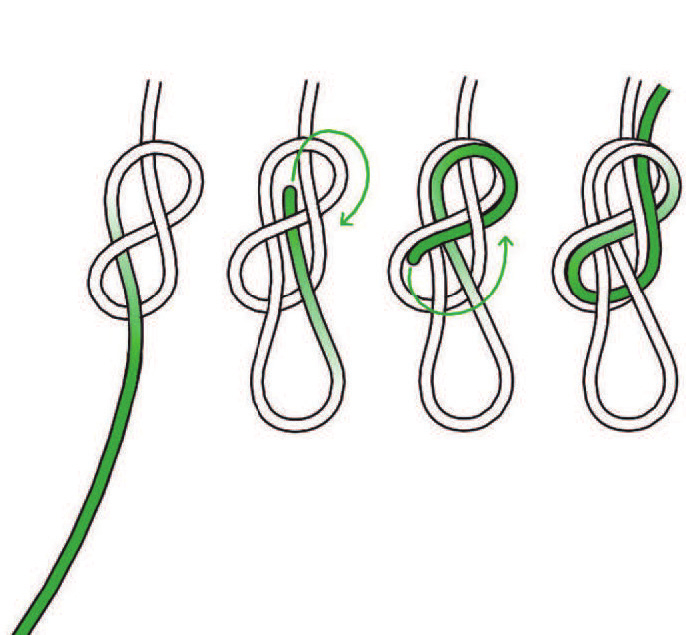
The figure eight follow through knot is the preferred tie-in knot throughout North America. It is easy to inspect, relatively easy to untie after being loaded by body weight, and it is a highly secure knot that will not untie without external manipulation. A properly tied figure eight follow through knot will possess the following characteristics: minimal twists in the rope throughout the knot; tight and consistent bends throughout the knot; and a minimum of ten centimetres of 'tail' extending from the knot.
The figure eight follow through knot can also be used to connect two different materials such as nylon webbing and a static rope in an anchor configuration, or to connect static rope to a natural anchor point such as a tree.
Figure Eight on a Bight
The figure eight on a bight is an efficient means of creating a closed loop in the end of a rope when the end does not need to be passed through or around an object. A properly tied figure eight on a bight will possess the same characteristics as a properly tied figure eight follow through knot.
Double Fisherman's
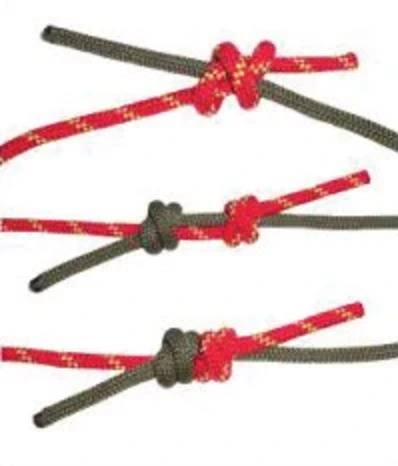
The double fisherman's knot is an in-line knot that is used to join two ends of similar diameter rope together. In the top rope climbing context its primary applications are to create a closed loop in cord, and to connect the ends of a static rope in an anchor configuration. A properly tied double fisherman's knot will demonstrate the opposing double overhand knots seated together in unison; and each knot will possess a minimum of 10 centimetres of tail.
Flat Overhand Knot
In low-load scenarios that are body weight or less, a flat overhand knot can be used to connect two ends of similar diameter rope. In the top rope climbing context, the flat overhand is primarily used to create closed loops in the tails of a 5 metre prusik cord or to connect a short prusik cord to the harness as a rappel back-up. A properly tied flat overhand will be free of excessive twists, possess tight and consistent bends, and a minimum of 10 centimetres of tail. Note – if a flat overhand is being used to connect two ropes in a rappelling application a second flat overhand should be tied behind the first and a minimum of 30 centimetres of tail should be present.
When connecting ends of low diameter slippery materials, such as technora cord or dyneema webbing, a triple fisherman's should be used in lieu of the double fisherman's or tape knot.
Tape Knot
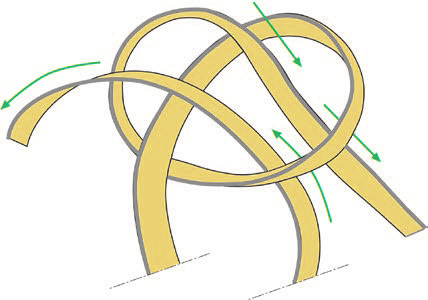
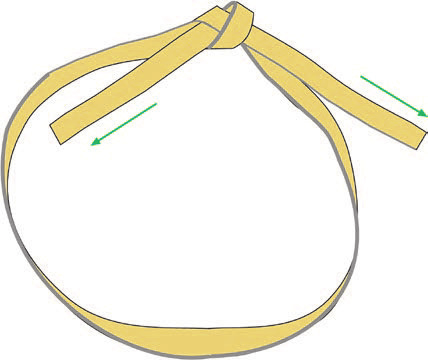
The tape knot, also commonly referred to as the water knot, is used to tie the ends of one-inch tubular webbing into a closed loop, or to connect two pieces of one-inch webbing together. A properly tied tape knot will sit flat with no twists and possess a minimum 10 centimetres of tail extending from both sides of the knot. Tape knots left tied in webbing will 'creep' over time, for this reason it is recommended that they be removed following each outing.
Double Overhand Knot
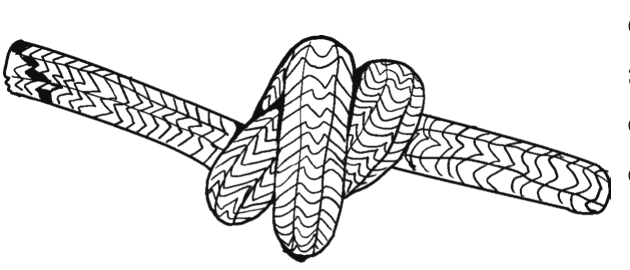
The double overhand knot is used as a blocking knot in the end of either a dynamic climbing rope or a static rope to prevent the rope from passing through a belay device. It is commonly used in lead climbing and rappelling applications. A properly tied double overhand knot will create an 'X' pattern in the rope, be tight on itself, and possess a minimum of 10 centimetres of tail.
Hitches
A hitch is similar to a knot however it has the ability to conform to the size and shape of the object to which it is connected.
Basket Hitch
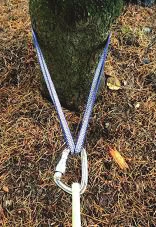
The basket hitch is commonly used to connect natural anchor points into a large anchor configuration, or to extend the focal point of an anchor. It is the least complex of all the hitches and involves little more than wrapping the hitch material around a fixed object.
Girth Hitch
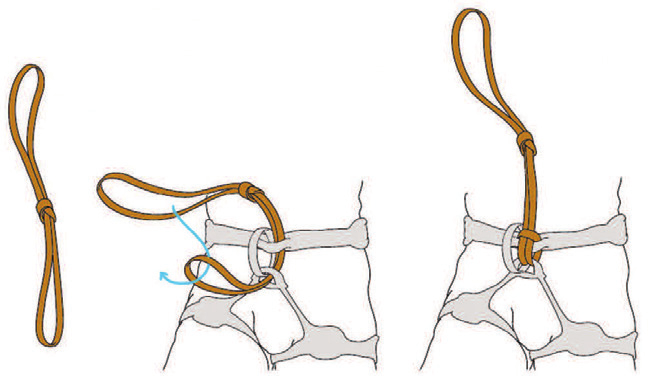
The girth hitch is commonly used to connect a sling to the tie-in points of the climbing harness for tethering and rappel applications.
Clove Hitch
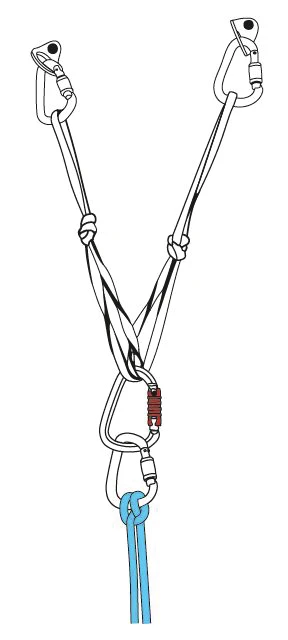
The clove hitch is commonly used to create an adjustable tether when connecting to an anchor with the climbing rope.
Prusik
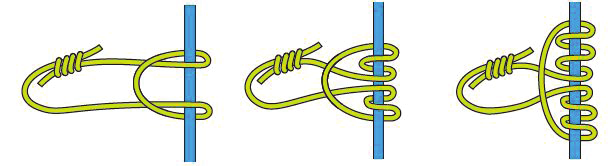
The prusik is a multi-directional hitch commonly constructed with cord, that provides rope grabbing properties. It is used to ascend both loaded and unloaded ropes, as a means of backing up a rappel, and in rescue applications. Two or three wraps may be required depending on the difference in diameter between the cord and the climbing rope, or whether the prusik is being used in a load-bearing application or as a back-up. In load-bearing applications, a three wrap prusik should be used. In non-load bearing applications where the prusik is acting solely as a back-up, such as rappelling with a prusik below the rappel device, two wraps may be preferable.
Italian Hitch
The Italian hitch is a multi-directional, friction-creating hitch that can be constructed on any large locking carabiner. It is commonly used when belaying and lowering a top roping climber from above.
Compared to modern manual braking belay devices, the Italian hitch has relatively low friction creating properties. In instances were an Italian hitch is being used with a large load such as a heavy participant being lowered down very steep terrain, a second locking carabiner of identical size can be connected to the anchor and incorporated into the hitch to increase the friction.
Top Rope Belaying
Top rope belaying is a means of moving the climbing rope through a belay device or friction creating hitch, eliminating slack in the top rope climbing system and decreasing the potential distance a climber would fall.
Top Belaying
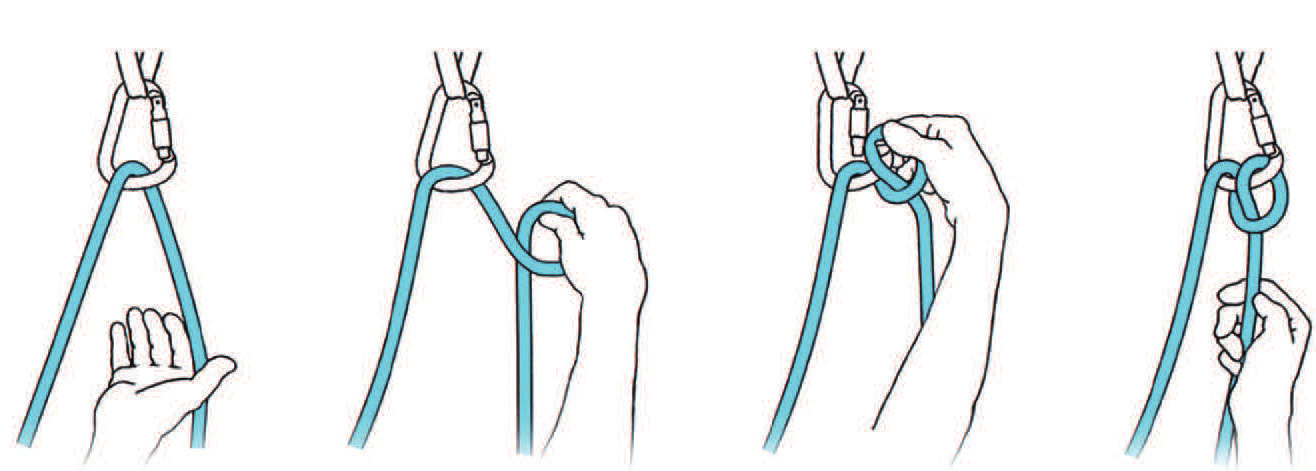
Top belaying occurs in situations where the top rope belay is being provided from above rather than below. In these instances it is preferable for the belay to be provided directly off the anchor instead of the belayer's harness. The comfort of the belayer should be thoughtfully considered when determining the positioning of the anchor and an Italian hitch connected directly to the focal point of the anchor used to belay.
Manual and Assisted Braking Belay Devices
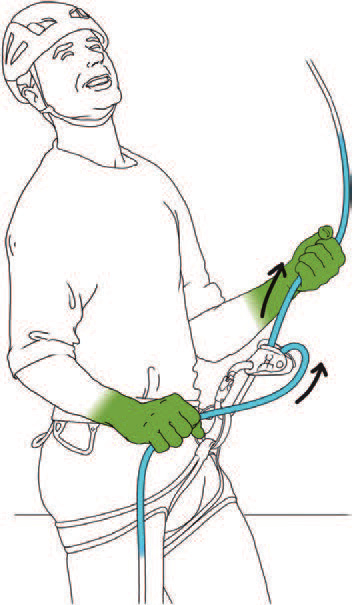
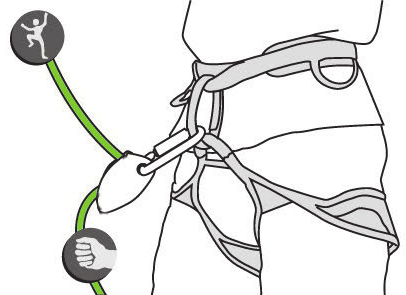
When belaying with either a manual or assisted braking belay device, the friction creating properties of the device are maximized by forcing tight bends into the rope, or enabling the binding action of the belay device to properly engage. Regardless of the device used, the belay pattern should remain consistent and involve the belayers brake hand continuously in control of the brake rope. The brake hand should also be positioned below the device in the most mechanically advantageous position any time slack is not being removed from the top rope climbing system.
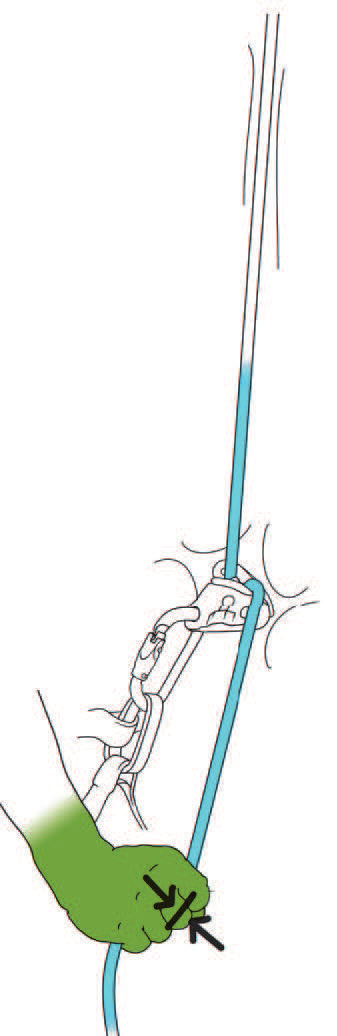
Italian Hitch
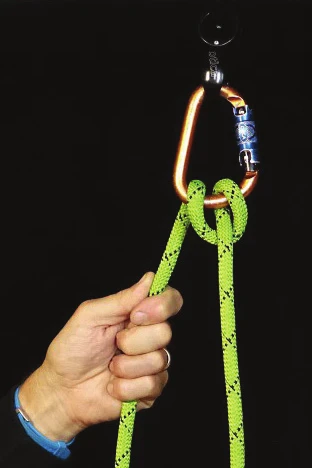
Similar to modern belay devices the Italian hitch creates friction by forcing bends into the climbing rope. Unlike manual and assisted braking belay devices, the friction creating properties of the Italian hitch are maximized when the brake rope is placed parallel to the rope connected to the climber. For this reason, the hand pattern used when belaying with an Italian hitch differs somewhat from typical belay techniques. The brake hand must continuously maintain control of the brake rope; however, it should do so in a manner that keeps the brake rope parallel to the rope connected to the climber at all times.
Rappelling
Rappelling enables a top rope leader to quickly and efficiently descend a non-loaded climbing rope or static rope. Rappelling requires the use of a manual or assisted braking device, and can be completed on a single fixed line or a doubled rope threaded through an anchor. If using a manual braking device, the rappel also requires a back-up. If the back-up is a prusik, then the belay device should be extended from the harness using a girth hitched sling.
System Set-Up
Fixed Line Rappel Set-Up
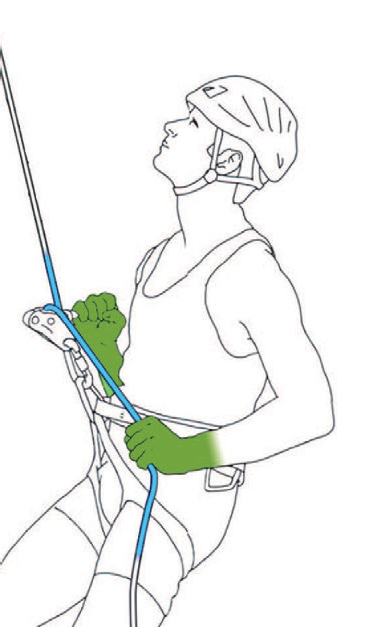
A fixed line rappel can be completed on either a static or dynamic climbing rope by connecting the fixed line to an anchor. The connection between the fixed line and the anchor should be completed by tying a figure eight on a bight in the end of the fixed line and connecting it to the master point of the anchor with a locking carabiner. Either a manual or assisted braking device is then placed on fixed line and connected to the top rope leaders harness with a locking carabiner. If a manual braking device is being used, additional friction will be required and can be created by using a second identical locking carabiner to connect the belay device to the belay loop. Prior to commencing a rappel, a double overhand knot must be tied in the free end of the rope to prevent the rappeler from accidently descending off the end of the rope.
Threaded Anchor Rappel Set-Up
A threaded anchor rappel can be completed on either a static or dynamic climbing rope by threading the rope through the master point of an anchor, or a set of rappel rings. Both ropes are then placed into a manual braking belay device which is then connected to the belay loop of the top rope leaders harness, or a sling if extending the rappel device, with a locking carabiner. Prior to commencing a rappel, double overhand knots must be tied in the free ends of the rope to prevent the rappeler from accidently descending off the ends of the rope.
Backing Up a Rappel
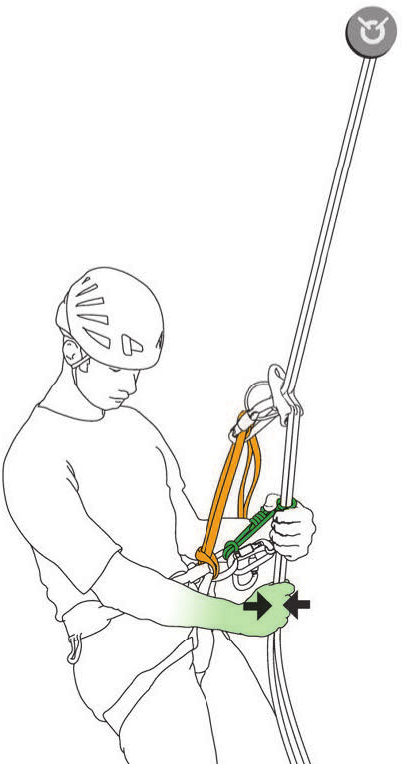
Backing Up a Rappel With a Prusik
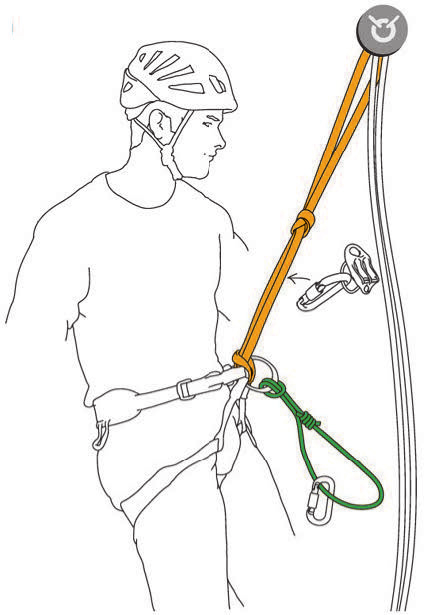
A rappel can be backed up quickly and effectively by adding a prusik to the brake strand(s) below the extended belay device. A two-wrap prusik may be used for a double rope rappel, and a three-wrap prusik should be used for a single rope rappel. The prusik is connected to the harness by tying it to the belay loop with a flat overhand knot. It is imperative that the distance between the prusik and the knot connecting it to the belay loop be kept to approximately 10 centimetres, so that the belay device does not accidentally mind the prusik.
Backing Up a Rappel With a Belay From Below
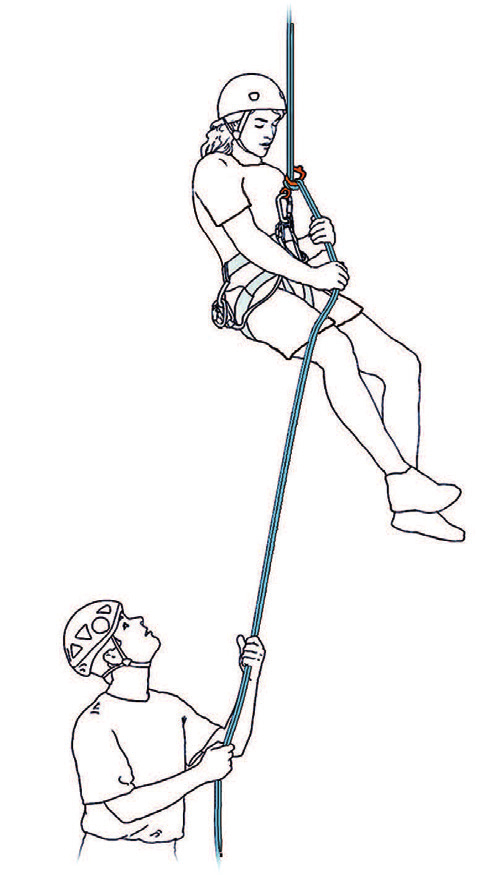
A rappel can be backed up from below by a trained participant or an additional top rope leader managing the brake rope or ropes from the ground. In the event that the descent needs to be stopped, the individual on the ground applies tension to the brake rope(s) thus acting as a set of brake hands.